
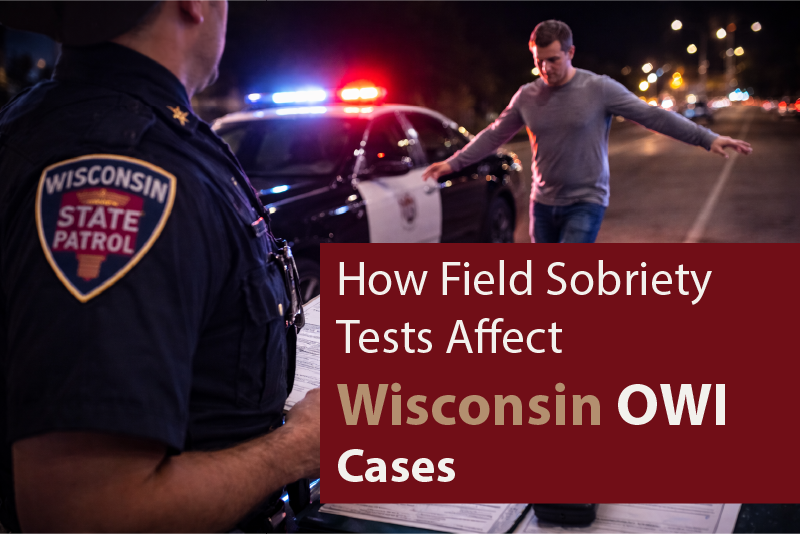
How Field Sobriety Tests Affect Wisconsin OWI Cases
Field sobriety tests (FSTs) are roadside exercises used by law enforcement to help determine whether a driver may be impaired. In Wisconsin OWI cases, these tests are used to establish probable cause for arrest and may later be introduced as evidence in court. However, FST results are not chemical tests, and their reliability can be affected by environmental conditions, physical limitations, and officer interpretation.
What Are Field Sobriety Tests?
Field sobriety tests are standardized roadside exercises developed to help officers assess potential impairment.
The three standardized tests most commonly used are:
- Horizontal Gaze Nystagmus (HGN)
- Walk-and-Turn
- One-Leg Stand
These tests are intended to measure divided attention skills – the ability to perform physical and cognitive tasks simultaneously.
Unlike breath or blood testing, field sobriety tests do not measure alcohol concentration. They are observational tools.
How Field Sobriety Tests Are Used in Wisconsin
FSTs primarily serve two legal functions:
- Helping an officer determine whether probable cause exists to make an arrest.
- Providing observational evidence that may be introduced at trial.
In many cases, the officer’s decision to request chemical testing is based in part on field sobriety test performance.
For an overview of how chemical testing decisions affect OWI cases, see: Should You Refuse a Chemical Test in a Wisconsin OWI Case?
Are Field Sobriety Tests Mandatory?
In Wisconsin, field sobriety tests are typically voluntary. They are distinct from chemical testing under the implied consent law.
Refusing field sobriety tests does not trigger the same automatic license consequences as refusing a breath or blood test.
For a discussion of how license consequences begin after arrest, see: Is Your License Suspended Immediately After an OWI in Wisconsin?
Limitations of Field Sobriety Tests
Field sobriety tests are designed to be administered under standardized conditions. However, real-world circumstances often vary.
Performance may be affected by:
- Uneven pavement
- Poor lighting
- Weather conditions
- Footware
- Fatigue
- Medical Conditions
- Nervousness
Because these tests rely on officer observation and scoring, interpretation may vary.
How Courts View Field Sobriety Tests
In Wisconsin OWI cases, FST evidence is generally used to support probable cause and to provide circumstantial evidence of impairment.
Courts examine whether:
- The officer had reasonable suspicion to begin the investigation
- The tests were administered according to standardized procedures
- The observations support the officer’s conclusions
FST results alone do not establish alcohol concentration. They are one component of the State’s overall case.
For a broader overview of how an OWI case proceeds after arrest, see: What Happens After an OWI Arrest in Wisconsin
Field Sobriety Tests vs. Chemical Tests
Field Sobriety Tests vs. Chemical Tests
- Field sobriety tests (observational)
- Preliminary breath tests (screening tools)
- Evidentiary breath or blood tests (chemical measurements)
Chemical test results carry different evidentiary weight and may trigger separate administrative proceedings.
For more information about license consequences related to chemical testing, see: Administrative Suspension & DMV Hearings After an OWI Arrest
Why Field Sobriety Tests Matter
Because FST performance often forms part of the probable cause analysis, the way tests are administered and documented can affect how an OWI case develops.
In many cases, body camera and squad video footage becomes important in evaluating how the tests were conducted and interpreted.
Understanding the role of field sobriety tests helps clarify how roadside investigations transition into formal OWI charges.
For general information about defending OWI charges, see: Wisconsin OWI Defense Lawyer
Final Note
Field sobriety tests play a significant role in Wisconsin OWI investigations, particularly in establishing probable cause for arrest. However, they are observational tools rather than chemical measurements and are evaluated alongside other evidence in a case.
Understanding how these tests are used provides context for how roadside investigations develop into formal OWI charges.
Frequently Asked Questions
OWI Defense Practice Areas
Serving Madison & Southern Wisconsin
We represent individuals charged with felony and misdemeanor OWI offenses throughout central and southern Wisconsin including in Dane, Rock, Iowa, Green, Columbia, Dodge, Sauk and Jefferson Counties.
Facing an OWI Charge?
Speak with a Wisconsin OWI Defense Attorney – Free and confidential consultation.