
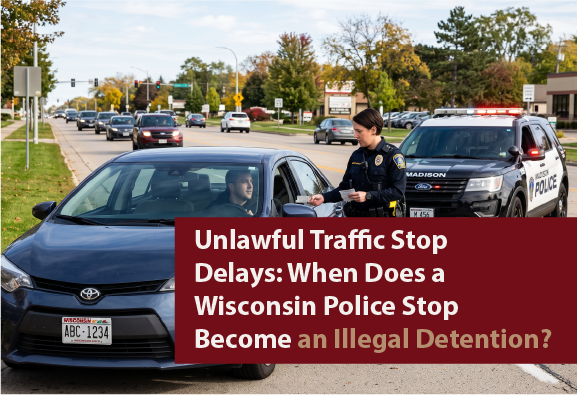
Unlawful Traffic Stop Delays: When Does a Wisconsin Police Stop Become an Illegal Detention?
It is a familiar scenario on Southern Wisconsin roadways: you are pulled over for a minor traffic infraction – such as a burnt-out license plate light, an expired registration sticker, or traveling 7 mph over the speed limit.
The officer collects your driver’s license, steps back to their squad car, and then the waiting begins. Ten minutes pass. Then fifteen. Instead of returning with a warning or citation, a second police vehicle arrives, or a K9 drug-sniffing unit pulls up along the shoulder.
Many drivers assume that as long as the initial traffic stop was lawful, police can take as much time as they want to ask questions or wait for back-up. Under both federal and Wisconsin constitutional law, this assumption is wrong.
An officer cannot indefinitely extend a routine traffic stop to conduct a “fishing expedition” for criminal activity. When police unconstitutionally prolong a stop, any physical evidence seized – whether drugs, weapons, or field sobriety results – can be suppressed in court.
At Chirafisi Anderson, S.C., our litigation team audits police squad videos and body-camera timestamps to identify unlawful detentions and throw out illegally obtained evidence.
The “Mission” of the Stop: The Rodriguez Standard
Under the Fourth Amendment of the U.S. Constitution, a traffic stop is legally treated as a brief investigatory seizure. Its lawful duration is strictly limited by the “mission” of the stop itself.
According to the United States Supreme Court’s landmark decision in Rodriguez v. United States, the authority for a traffic seizure ends when tasks tied to the traffic infraction are – or reasonably should have been – completed.
Permissible Tasks During a Traffic Stop:
Under Wisconsin law, an officer’s permissible “traffic mission” is limited to:
- Checking the driver’s license, vehicle registration, and proof of insurance.
- Running a computer check for outstanding warrants.
- Briefly asking routine questions about travel plans.
- Writing and issuing the traffic warning or citation.
Once those routine tasks are done – or if an officer intentionally delays writing the ticket to wait for a drug dog or second officer to arrive – the stop becomes an unconstitutional seizure unless police have independent reasonable suspicion of a separate crime.
The Wisconsin Benchmark: State v. Wiskowski
Wisconsin courts strictly enforce these Fourth Amendment protections. In the landmark decision State v. Wiskowski, the Wisconsin Supreme Court ruled that even if an initial stop or welfare check is lawful, police cannot unreasonably prolong the detention once the initial justification for the stop has been resolved.
In Wiskowski, police responded to a driver who had fallen asleep in a drive-thru. After pulling the driver over and observing no signs of intoxication or impairment, the responding officer prolonged the stop to check the driver’s prior record, eventually ordering him out of the vehicle for sobriety tests.
The Supreme Court reversed the conviction and ordered the evidence suppressed, holding that because the officer lacked reasonable suspicion of a crime after resolving the initial inquiry, extending the stop transformed it into an illegal criminal investigation.
Common Ways Police Illegally Extend Traffic Stops
Law enforcement officers are trained to ask probing questions during routine stops to generate “reasonable suspicion” on the fly. Common tactics that cross the constitutional line include:
- Delaying the Citation for K9 Units: An officer cannot pause or slow down writing a ticket simply to give a K9 drug-sniffing unit time to arrive at the scene.
- Conducting Unrelated Fishing Inquiries: Asking extensive questions about a driver’s criminal history or personal background that significantly prolong the duration of the stop.
- Community Caretaking Detours: Using a minor welfare check or motorist assist as a pretext to launch a full criminal investigation without observing signs of impairment or wrongdoing.
If police prolong a stop without specific, articulable facts justifying the delay, any evidence gathered after that delay – including drug evidence, firearms, or breath/blood tests – is classified as “fruit of the poisonous tree” and must be suppressed.
Defense Strategies: Auditing squad Video and Timestamps
Winning a motion to suppress based on a prolonged traffic stop requires minute-by-minute evidentiary precision. At Chirafisi Anderson, S.C., our litigation team approaches traffic stops with a meticulous audit process:
- Timestamp Reconstruction: We cross-reference squad car dash-cam video, officer body-camera footage, and dispatch logs down to the exact second. We calculate how long it took to run driver’s license checks versus how long the officer stalled writing the citation.
- Challenging “Reasonable Suspicion”: Prosecutors often claim the officer smelled something or noticed “nervousness” to justify delaying the stop. We cross-examine officers at evidentiary hearings to prove these claims are vague, uncorroborated, or manufactured after the fact.
- Filing Motions to Suppress: If the timeline proves the officer detoured from the traffic mission without legal justification, we file a Motion to Suppress Evidence under the Fourth Amendment and Article I, Section 11 of the Wisconsin Constitution.
Protect Your Constitutional Rights
You do not lose your constitutional protections simply because you were pulled over on a highway in Dane, Rock, or Jefferson County. If an officer prolonged your traffic stop without clear cause, the state’s criminal case against you may be built on an unconstitutional foundation.
At Chirafisi Anderson, S.C., we do not hesitate to challenge law enforcement overreach in court. When we successfully prove an illegal detention, the physical evidence is suppressed – frequently leading to a complete dismissal of all criminal charges.
Learn more about our OWI Defense Strategies in Wisconsin OWI Cases.
Frequently Asked Questions
Serving Madison & Southern Wisconsin
We represent individuals charged with misdemeanor, felony and OWI offenses in Madison and throughout Dane, Rock, Iowa, Green, Columbia, Dodge, Sauk and Jefferson Counties.
Facing a Criminal Charge?
Speak with a Wisconsin Criminal Defense Attorney – Free and Confidential Consultation.