
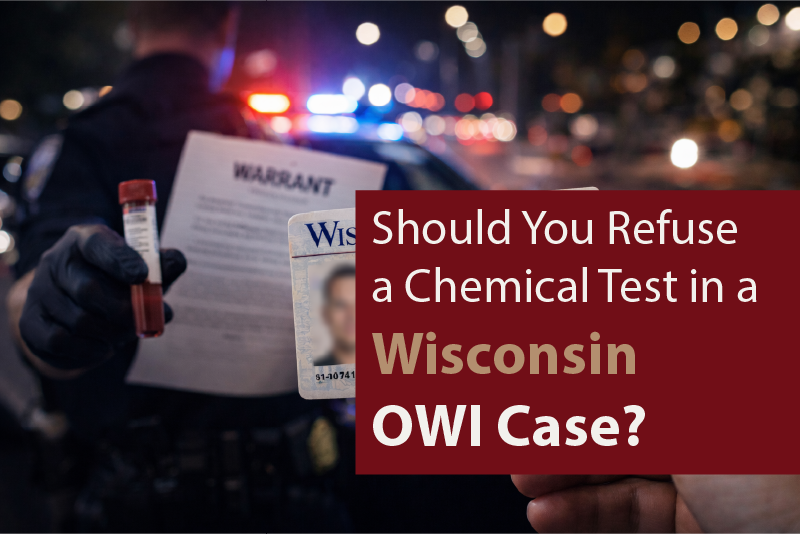
Should You Refuse a Chemical Test in a Wisconsin OWI Case?
In most Wisconsin OWI cases, refusing a chemical test does not prevent law enforcement from obtaining a blood sample. Officers frequently seek a warrant and obtain blood evidence even after a refusal. Refusal also triggers a separate legal proceeding that can result in license revocation and additional penalties. For many drivers, refusing testing does not eliminate chemical evidence and can create additional legal exposure.
What Happens After a Refusal in Wisconsin?
Under Wisconsin’s implied consent law, a driver who refuses a requested chemical test faces a separate refusal proceeding. However, a driver is only entitled to a separate refusal proceeding if they timely file the request for a hearing within 10 business days.
Refusal can result in:
- License revocation
- Ignition interlock device (IID) installation
- A separate court hearing
- The refusal being used as evidence in the OWI case
Refusal does not prevent prosecution for OWI. It creates an additional legal issue. Learn more at our Chemical Test Refusal in Wisconsin OWI Cases page.
The Warrant Issue: Why Refusal Often Doesn’t Stop Chemical Testing
It is common in Wisconsin for law enforcement to seek a warrant if a driver refuses testing. Courts routinely authorize blood draws when probable cause exists.
As a result:
- Refusal does not guarantee the absence of a blood result
- The State may still obtain alcohol or drug concentration evidence
- The case may proceed with both a refusal charge and chemical test evidence
This is an important practical reality that many drivers do not realize at the roadside.
Do Refusal Defenses Differ From OWI Defenses?
In many cases, they overlap. Refusal proceedings typically examine issues such as:
- Whether probable cause existed for the arrest
- Whether the officer properly informed the driver of testing consequences
- Whether statutory procedures were followed
These same issues often form the foundation of suppression challenges in the OWI case itself. If probable cause was lacking, it may undermine both the OWI and Refusal charge.
For a broader discussion of how constitutional and procedural challenges affect OWI cases generally, see: Wisconsin OWI Dismissals and Defenses.
Is Refusal Better Than Blowing Over the Limit?
In practice, it is uncommon that refusal leaves a driver in a stronger legal position. Submitting to testing may produce an unfavorable result, but it does not create an additional refusal proceeding. The strategic implications depend heavily on prior history, suspected impairment type, and case-specific facts. There is no universal rule that refusal is advantageous.
How Refusal Can Affect License Consequences
Refusal cases typically result in license revocation rather than administrative suspension. The revocation period can vary depending on prior history.
These revocations are separate from court-imposed penalties and may affect eligibility for occupational driving privileges.
Refusal Does Not Automatically Improve the Criminal Case
A common misconception is that refusing makes it harder for the State to prove OWI. While refusal may complicate the evidentiary picture (if no warrant is obtained), prosecutors can still rely on:
- Officer observations
- Field sobriety tests
- Statements made during the stop
- The fact that you refused testing showing consciousness of guilt
Refusal changes the structure of the case – it does not eliminate prosecution.
For an overview of how the case proceeds after arrest, see: What Happens After an OWI Arrest in Wisconsin
Final Considerations After an OWI Arrest
The roadside decision whether to submit to testing is often made under stress and without full information. In Wisconsin practice, refusal frequently leads to both a separate revocation proceeding and, in many cases, a warrant-authorized blood draw.
Understanding how refusal interacts with the OWI case requires careful evaluation of the specific facts, prior history, and procedural issues involved.
For information about OWI cases generally, see: Wisconsin OWI Defense
Frequently Asked Questions
OWI Defense Practice Areas
Serving Madison & Southern Wisconsin
We represent individuals charged with felony and misdemeanor OWI offenses throughout central and southern Wisconsin including in Dane, Rock, Iowa, Green, Columbia, Dodge, Sauk and Jefferson Counties.
Facing an OWI Charge?
Speak with a Wisconsin OWI Defense Attorney – Free and confidential consultation.