
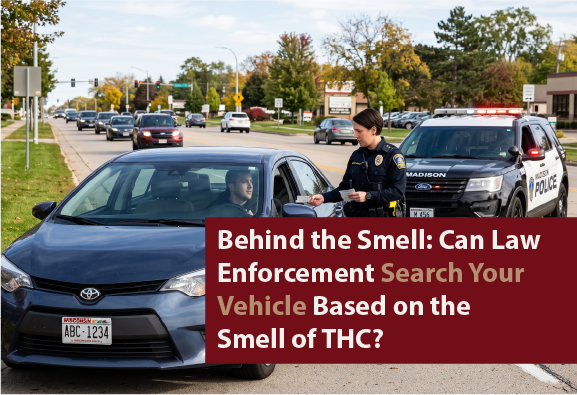
Behind the Smell: Can Wisconsin Police Search Your Car Based Only on Marijuana Odor?
As neighboring states like Illinois and Minnesota have legalized recreational cannabis, thousands of drivers travel across Southern Wisconsin highways every day assuming that the legal status of marijuana is shifting uniformly across state lines.
However, crossing the state border into Dane, Rock, or Jefferson County places you under a dramatically different constitutional standard.
When a routine traffic stop on I-94 or the Beltline escalates because an officer claims to “smell marijuana” coming from your vehicle, many drivers assume that without a search warrant or physical evidence in plain view, law enforcement cannot search the vehicle or its occupants. Unfortunately, under current Wisconsin law, law enforcement is granted vast latitude – making a proactive, trial-tested defense essential if a stop leads to drug or firearm charges.
At Chirafisi Anderson, S.C., our criminal defense team regularly deconstructs pre-textual traffic stops to challenge illegal searches and suppress improperly seized evidence.
The “Plain Smell” Doctrine: How Wisconsin Courts Treat Marijuana Odor
Under the Fourth Amendment, law enforcement officers generally need a search warrant or a recognized warrant exception to search your vehicle or your person. However, Wisconsin courts apply the “Plain Smell” doctrine.
Under long-standing precedent (State v. Secrist) updated by the landmark Wisconsin Supreme Court ruling in State v. Moore, the uncorroborated odor of marijuana emanating from a vehicle provides officers with sufficient probable cause to search both the vehicle and its occupants – even if the driver is the sole occupant and no physical drugs are in plain sight.
The CBD and Legal Hemp Dilemma
The major legal fault line in these searches centers on legal hemp and CBD. Under federal and Wisconsin law, industrial hemp and hemp-derived CBD products containing less than 0.3% Delta-9 THC are entirely legal.
Because illegal marijuana and legally permitted CBD or raw hemp possess identical chemical terpenes, they smell exactly the same.
While defense teams argue that an officer cannot distinguish legal CBD from illegal cannabis based on smell alone, Wisconsin courts currently hold that officers are not required to rule out innocent explanations during a stop. If an officer claims to detect the odor, the court allows them to execute a warrantless search.
The Pretextual Search: How “Odor” Is Used to Target Drivers
Because an officer’s claim of smelling marijuana is inherently subjective and unverified by roadside tests, law enforcement frequently uses the “plain smell” doctrine as a legal justification to conduct broad, fishing-expedition searches.
What begins as a minor traffic stop for a burned-out license plate light or 5-mph speeding ticket can quickly transform into a deep vehicle search yielding charges for:
- Felony Drug Possession or Intent to Deliver Charges (such as cocaine, prescription pills, or synthetic opioids)
- Carrying a Concealed Weapon or Felon in Possession of a Firearm Charges
- Operating While Intoxicated Charges
In many cases, officers conduct these searches, fail to find any marijuana whatsoever, but attempt to prosecute drivers for other items seized during the sweep.
Defense Strategies: How We Challenge “Odor” Searches in Court
Just because an officer claims they smelled marijuana does not mean the evidence they seized is automatically admissible in court. Winning a drug case built on a vehicle search requires aggressively attacking the constitutional validity of the initial stop and the officer’s credibility through a Motion to Suppress Evidence.
Our litigation strategy scrutinizes every second of the encounter:
- Challenging the Initial Traffic Stop: Officers must have reasonable suspicion or probable cause to pull your vehicle over in the first place. If the initial traffic stop was illegal, any evidence seized during the subsequent “odor search” must be thrown out as “fruit of the poisonous tree.”
- Auditing Squad & Body-Camera Footage: We analyze body-worn camera audio and video to track the timeline. Did the officer mention an odor immediately, or did they only claim to smell marijuana after the driver declined a voluntary search request?
- Proving Unlawful Stop Extensions: Under federal constitutional law (Rodriguez v. United States), police cannot unnaturally prolong a routine traffic stop to wait for K9 drug-sniffing units or conduct fishing inquiries without independent reasonable suspicion.
- Exposing Officer Credibility Gaps: Through rigorous cross-examination at suppression hearings, [Link to Sandbox Post: our trial attorneys] put arresting officers under oath to challenge their training, wind/environmental conditions at the scene, and past search records.
Don’t Let an Unlawful Search Define Your Future
If you were pulled over in Dane County or Southern Wisconsin and police searched your car based on an alleged smell of marijuana, the prosecution’s case relies entirely on constitutional technicalities. When we successfully challenge the officer’s authority or suppress the physical evidence, the State’s entire case often collapses before it ever reaches a jury.
At Chirafisi Anderson, S.C., we do not sit back and accept police reports as truth. We litigate constitutional violations aggressively to protect your record, your rights, and your freedom.
Frequently Asked Questions
Related Search and Seizure Posts
- Unlawful Traffic Stop Delays: When Does a Wisconsin Police Stop Become an Illegal Detention?
- Warrantless Police Entry in Wisconsin: Exigent Circumstances, Consent, and Your Rights
Serving Madison & Southern Wisconsin
We represent individuals charged with misdemeanor, felony and OWI offenses in Madison and throughout Dane, Rock, Iowa, Green, Columbia, Dodge, Sauk and Jefferson Counties.
Facing a Criminal Charge?
Speak with a Wisconsin Criminal Defense Attorney – Free and Confidential Consultation.